Sunday, 24 October 2010

'Private lives' – or the unavoidable immersion in them by the peripatetic visitor

So much has happened since our last post. Our visitors have motivated us to get off our seats and see some things – some new, some revisits. We have been to the Cinque Terre (the five lands) on Italy's north-west coast, to Assisi and other Umbrian delights, and to Tivoli in Lazio – not to mention more and more of Roma itself.

Cinque Terre
The point is, that during these excursions, far more so than in Australia, we are blessed to find ourselves privy to some very private – very special – very family – very emotional events. Brides and grooms are a navigation hazard here in Italy. They are everywhere and can be found at almost any time. Mostly they are just with their photographers, but sometimes we stumble upon the wedding in full flight, with lots of guests, mingling with lots of observers – like us. The guests might prefer to chat outside, maybe drink an aperitivo or two (aperitivi I guess), certainly smoke and catch up with those vital mobile phone calls.

Wash day
But we did strike one huge wedding in the Cinque Terre where the photographer did ask for all the “invited” guests to form up on the church steps for the photograph – my bride just escaped being recorded in the family album as she emerged from the church door having gone to look at the (somewhat elaborate) flowers.  Incidentally, the Cinque Terre are no cake walk around the coast (except for the one short section known as Via del Amore (the way of love) - to get from one town to the next requires the skills and resilience of a goat.

And so to Assisi – home (or resting place) of St Francis of ….. same name! And of course of his contemporary, St Chiara (or Clare) of the Poor Clares. This time, while visiting the church in which both Francis and Clare we baptised (13th century) we joined in with another baptism – in the exact same font that held Francis and Clare.

St Mary
Speaking of saints – we took the opportunity to witness the canonisation of Australia's own – Saint Mary of the Cross, McKillop. A much grander affair than the wedding or baptism, but still an insight into the public ceremonies that make private life click here in Italy.
Il Papa drives past


This time, because I had so many photos that I wanted to show you – I keep the text short and try to juggle the blog-site and its peculiar ways of handling pictures.

The Protagonist steps forward
The shots – apologies if too many – are (remember you can usually click on them to enlarge):

A demonstration or manifestioni – revolting students and their teachers take to the streets.

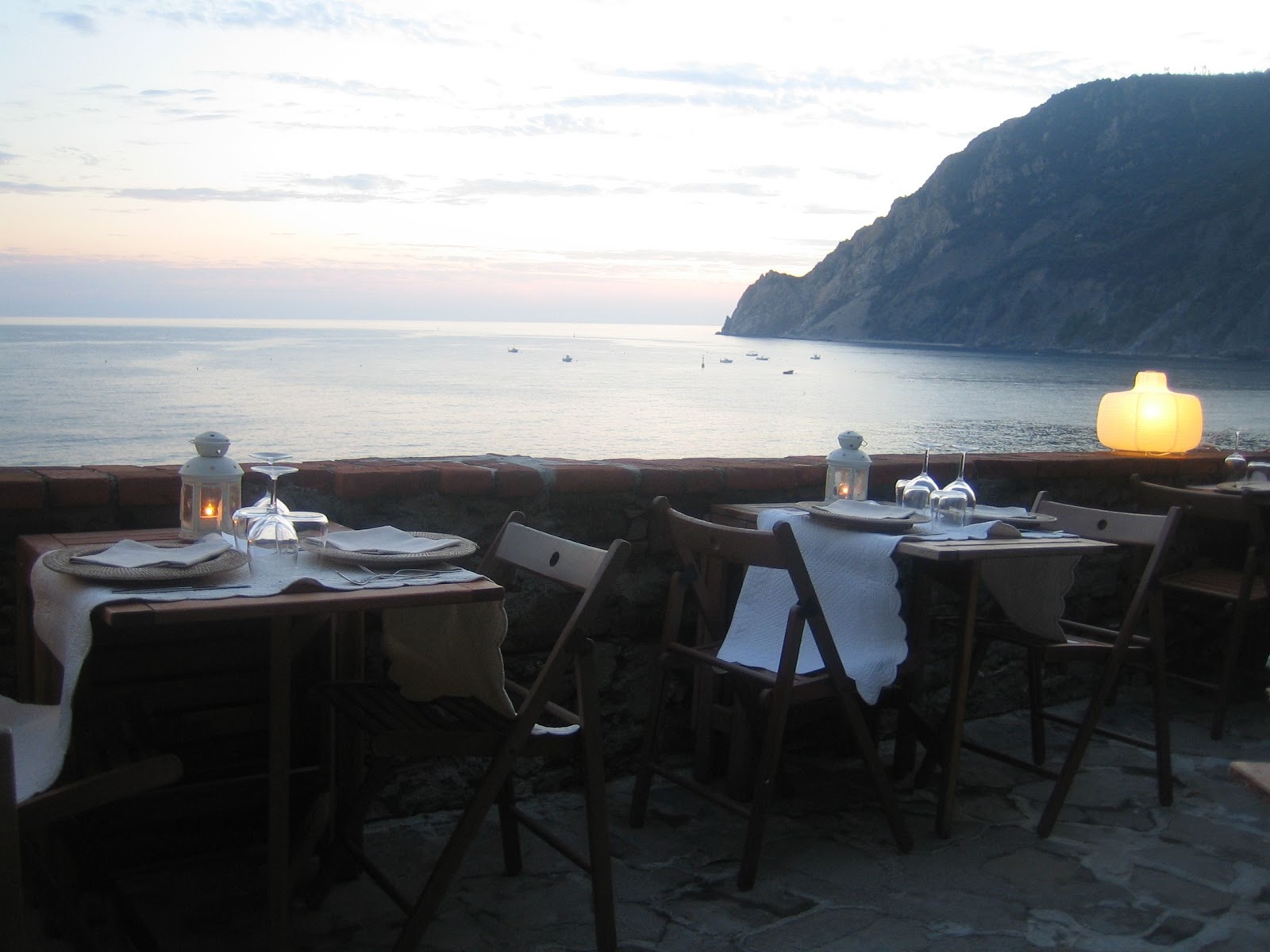
Views of Cinque Terre (above) including the blatant display of one's (previously) dirty washing, and three dishes that caught our eye and taste buds as the sun set behind us. Also a public fund-raiser for the missions replete with singing monk and conga-dancing cooks.

Various assorted brides including the steps-of-church photo opportunity (note the Douglas bride disappearing to the right).

The baptism and famous font in Assisi.

The coming of St Mary (and of the Pope only a spit away over the throng of fellow photographers).  Also a shot with a delightful nun in the foreground - I have met her in Rome a few times.  She was the official 'proponent' of Mary McKillop and so, had a key role in the ceremony.  She was one of the few nuns in modern dress.

And I have updated the signature photo of the “report” to acknowledge Italy-China Week which was celebrated by painting the Colosseum red (and I guess writing made in China on it – can't tell for sure).

A domani (or maybe next 'month')

Student demonstration

View from hotel window

Sundown dinner

Octopus salad

Seafood pasta

Another simple meal
Conga line to singing monk

Group photo being arranged
Escape from being in the group photo
Wedding at Assisi

Wedding at Bevania

Font for St Francis
Modern day baptism in the font
China week takes over the old girl


Sunday, 19 September 2010

The “Fall”, a “Fall” and making a “Splash” in Rome


They seem not to call autumn - “autumn” when they translate to English here but use the more Americanized “Fall”.  This even though “autonno” is the Italian name for this season twixt summer and winter, perhaps as a concession to visitors we hear “fall” here.
“Fall” is, after all, one of those English words that has a multiplicity of meanings in different contexts.  “Pride cometh before a fall”; “The fall of the Roman empire”; “She was a fallen woman”; “I had a bad fall”; “She will fall pregnant”; “He was the fall guy”; “The leaves will turn brown in the fall”. Any wonder we send English language students silly!
Italy does its seasons by the calendar rather than the month.  Australians tend to think of autumn as being March, April and May (if the world were upside down it would be September, October and November).  The solstices are critical in Italy, so the “autonno” begins on 22 September.
The scene of a full immersion
So, we are on the cusp of “fall”.
We have been in Rome, this time around, for just over twelve months (twice our previous “personal best”).  Today we farewelled our most recent Australian visitors (26th and 27th), so things are a bit lonely today.  Two other locals have “camped” in our apartment this year, rather than go home late at night, and another family of three Australians spent time with us but did not reside here.  I doubt that any have regretted their time in the eternal city, although a sense of humour has been a pre-requisite in some cases.
The Spanish Steps and the only available shade
Take for instance the sad story of our guest who travelled with her husband and the resident tour guide, “the bride”, to the Spanish Steps - Piazza di Spagna - famous for the house in which the poet Keats died of consumption and Babington’s Tea Rooms, the source of the fashionistas’ favourite, Via Condotti, and the home of a fountain that looks like a sunken ship - the latter designed by Bernini, the elder (Pietro) - the father of Bernini (Gian Lorenzo) who seems to have built most of the truly beautiful fountains in Rome. Perhaps it was a father and son effort.

Anyway, the Fontana della Barcaccia ("Fountain of the Old Boat") pours out what is reputed to be Rome’s sweetest water.  This was the fountain that Keats listened to whilst unwell and encouraged him to have his epitaph read “Here lies one whose name was writ in water” - deep!!!
Now this fountain has, at each end, a sort of island platform upon which one can carefully step forward to reach the spouts of water.  A little wet; a little slippery but legend has it (a new legend, established in September 2010), that the resident tour guide bravely stepped forth to fill her drink bottle - successfully.  But it seems that her guest also stepped forward and also crouched down to fill her bottle.  The tour guide, not recognizing this, stepped back triumphantly with full bottle and considerable momentum and the ensuing “bump” sent the guest face first into the pond below.
“Full immersion” they call it in baptismal terms, but in the middle of a thankfully warm day, in front of the madding crowds sitting on the Spanish Steps,  this was hardly a religious experience.
Famous graves in Protestant Cemetary
Our guest quickly recovered her composure and demanded of her husband - “I hope you got a photograph of that”.  Sadly, he didn’t, so I can’t show you a pictorial record of the fall but I do include an older picture of the fountain so you can get the idea.
Then there is the “fall from grace”.
Double parking is a Roman tradition - my guess is that they did it with their chariots.  But usually the double parkers show some restraint, at least to the passing traffic.  Not so good to those parked in perhaps, but they usually use the technique of sitting on their horns until the culprit appears and moves the car.
Double parking is not a feature of our little suburb.  Parking on zebra crossings and footpaths is, of course.  So imagine my surprise when aroused late yesterday morning by the loudest of horns repeatedly threatening to bring down our apartment’s walls.  When I looked out the bedroom window, here I saw a huge tour coach stuck on the street outside, and a small silver car double-parked blocking the road for anything larger than a car.
Now I put my keys here a little while ago ....
I thought “this I must get a photo of”, but when I returned with the camera, here was the culprit, desperately searching her handbag for her car keys.  It seems that the miscreant was a woman of the cloth - a good sister in full regalia.  This left the coach driver looking exasperated, the tour guide looking disbelievingly, and the passing pedestrian throng wondering what would be the penance for this fall from grace.
Caprarola
Villa Farnese
The Villa's garden
We have spent the last weeks continuing our explorations of the hill towns around Rome, including Caprarola replete with its spectacular Villa Farnese and gardens.
NZ Opera at Teatro Marcello
We were also guests of the New Zealand embassy to an opera recital held outdoors in the ruins of the Teatro Marcello.  This focused on the work of five opera students who had been brought to Italy to improve their Italian diction.  A great night and a unique experience.  Also interesting (and a little bit pleasing) was the fact that although a mild or closet opera buff for this past 40 years, this was the first time that I had listened to Italian opera and understood a significant amount of the lyrics.  Nowhere near all, but it was not just musical vocals but meanings.
Anyway, as the first trees look the tiniest bit brown, and as the summer heat gives way to cool mornings and moderate days, we include the following for your viewing pleasure.  The offending fountain - scene of the splash; the Spanish Steps on a hot day - me seeking out shade, others not; Keats' grave - Protestant Cemetery;  the double-parker; scenes of the Villa Farnese, Caprarola; the opera maestro at Teatro Marcello; and seeing Rome through beer glasses, or at least prosecco on our roof.
Prosecco'clock on our roof

Monday, 16 August 2010

How to live “Summer” in Italy

Today is “ferragosta” - the 15th August – an auspicious day in Italy.

It is, at least in Rome, perhaps the quietest day of the year. This afternoon there are few passing cars and motorinos, and the occasional sounds from the pavement below us drift in an unusually hollow manner through our open windows. The air is even calm with just a cool breeze drifting along through the bright sunny warmth of the middle of the day.

Ferragosta is the middle of the summer. Maybe it is, in truth, a little bit past the centre point and I am quite happy about that. With our heating and warm clothes, Rome's winter is cold but nothing to be feared. While the summer is brief by Brisbane's standards, I am already tired of sweat and having to seek the shady side of the street.

Like so many Christian feast days, today's feast of the assumption (or bodily passage to heaven) of Mary, was super-imposed on a pagan festival, in this case pre-Christian – but importantly, Roman. So “feriae Augusti” are the festivals of Emperor Augustus and at this time, after labouring long and hard in the fields, the locals kicked up a little and some say engaged in some serious wild living. Of course, these days the labours in the fields seem less with tractors and the wild living is probably a more consistent aspect of life.

The quiet scene in Rome has no less tourists but they will find their range of choices for dinner this evening much diminished. Many ristoranti, trattorie and pizzerie have shut their doors this weekend and many will not reopen in August. Their owners and waiters have headed to their traditional summer vacation destinations – many at the beaches or at resorts – Italian and foreign. If you seek a plane, train or bus ticket to anywhere much this weekend, you are likely to be disappointed. Everything has been booked out for weeks. We have to hope that we do not need a tradesperson in the next few weeks.

Summer is fleeting and so are the special summer activities. Romans are absolutely superb builders of temporary things (their ancestors good at building things that last, obviously). Through summer, there are all sorts of amusement venues that spring up within days and will come down again soon. There are concert venues in parks – that nearest us (Celiomontana) is a special jazz venue. There are temporary swimming pool “night-clubs” where the regazzi can swim and talk and chat. There are summer sports arenas, the stalls by the river bank, amusement parks and circuses. At the nearby beaches, around Ostia, there are beach clubs with miles of umbrellas and deck chairs.

So ferragosta is a much anticipated event and is like a mark on a perpetual calender.

For us, this long weekend is an opportunity to take a breath and catch up on doing “not much”. Yesterday we did drive two friends to the town of Orvieto – about 150 kms to the north. Another great little hill town with lots of ceramic shops and artisans. Dominated by the Duomo or cathedral, a 13th century structure that has that brilliant Byzantine influence. It is a bit of a museum and unless you can convince the “guard” that you are there for prayerful reasons, you pay an admission – not common for cathedrals in Italy. But the admission is worth it for the building's spectacular art, and especially the Brizio Chapel that is covered with detailed and spectacular frescos. Although producing immediate damnation to one's neck (most frescos are high up on the walls or ceilings), a little study of these frescos definitely has you thinking twice about being other than a “good boy”.

The scenes depict the differences between paradise and the other place, the end of the world and the resurrection of the dead. The devil supports the Anti-Christ and many wrong-doers get their just and gruesome deserts.

We had no deserts but lunch and dinner in Orvieto – lunch was just wonderful and just as well we were not all that hungry because perhaps the evening meal was not as good.

Orvieto is also unique in that it sits on a hill and lies on top of thousands of caves excavated in the soft volcanic stone. The material removed was used in building the houses above. These caves were made for the pressing of olives in consistently warm underground conditions, the storing of wine and the raising of pigeons. The walls sometimes have many pigeon holes in these columbaria – Columba is the genus name for pigeons. How do I know so much you say? Well we paid for the guided tour and it was beautiful – in really nice English and the guide truly had me transfixed.

Sadly no photos allowed inside the Duomo – so as an exception, I refer you to a web site if you are really keen to cover the eternal damnation story -


But some other photos including the outside of the Duomo. What is the collective name for around forty nuns running across the Piazza Duomo in a stiff breeze (a superfluity)? And later a civic band appears – and plays. Our guide (falling asleep it seems) in a cave. The original “pigeon holes”. A ceramics shop. The Umbrian countryside from Orvieto. And to show you we still exist – the Douglases and friend at supper in Orvieto.

Buona ferragosta


Sunday, 4 July 2010

Special spaces!!!

The last month or so had a bit of a slow period as my bride travelled to exotic Brisbane to see lots of people and celebrate a few special occasions. One such special occasion was the realignment of the North Yorkshire mob to Brisbane. So, without the motivation of the tour guide, I became somewhat of a stay-at-home, but I did venture to far flung shopping malls to “pick up a few things”.

I find little difficulty with my mate the TomTom in finding the centres but the car-park entrances are far from obvious. Anyway, a much needed study chair, some computer equipment and small speakers to enable us to hear DVDs were achieved.

During that period I did make a two night trip to Madrid. I had never been to Spain before but found Madrid to be an interesting if large city. A walking tour through some of the historic parts and a couple of very fine meals left me with happy memories and a desire to return sometime as a tourist. The fact I was not a tourist was perhaps best typified by my failure to take a camera – hence not much picto-graphically on Madrid, except that I was impressed by the chandelier in the conference room I sat in so, captured it with my phone during a quieter interlude.


On the bride's return, we got moving again and used our spare weekend days for some country drives. This weekend and last, we had Saturday drives to see two very special spaces – sacred spaces!

At the suggestion of our Kiwi friends, we went to Subiaco where two Benedictine monasteries exist.  In the 6th century, St Benedict spent three years as a hermit near the old site of one of Nero's holiday homes, and they later built a series of churches and chapels attached to the cave in which he spent his time. They are of course, now very old and ooze that monastic atmosphere. A second, more monasterial monastery, Santa Scholastica's, is nearby but below the cave. Scholastica was Benedict's twin sister by the way and this monastery (abbey) was where the very first printing was ever done in Italy. You see they were very 'scholastic' there. And a lot of the lovely marble was prefabbed and brought up from Roma.

How do I know so much you say. Well after a simple but very nice five course lunch in the monastery refectory, we joined in an excellent Italian language guided tour of the place and this delightful young Italian woman had us enthralled with her knowledge, clear Italian pronunciation and brown eyes.

Incidentally, the inspiration for Subiaco oval is unexplained – not enough space for a bowling alley in the real Subiaco, much less an AFL ground. And we did kind of hurtle through it on the way out as the storm that had been threatening for hours broke on us and poor Pierre the Peugeot had to bravely deflect some hail stones.


The second special space was entered yesterday at Assisi – the home of St Francis (you know – of Assisi). A delightful Umbrian hill town; a monastery, a bunch of other churches; stunning frescos in the renaissance style (much more recent than Subiaco's middle age ones); and an exquisite dinner over-looking the late evening countryside before a night drive home to Rome. Assisi really is Franciscan, but it is also so neat and pleasing to look at. Of course, why it is so neat is largely because it had to be rebuilt under UNESCO patronage after the devastating earthquake of the 90s. Very hilly but bedecked in pink building stones that change colour as the day fades. Down three levels below the monastery lies St Francis's tomb and an extremely sacred atmosphere of silence with many devoted followers flocking to the place. Our arrival home around midnight meant that we saw the Umbrian countryside lit up by the quite intense population and landmarks like the Spoleto fort glowing and twinkling in their night-time illuminations.


And the final special place – just 100 metres from our front door – my barber's shop. Now I suspect that he has been cutting hair for around 70 years now, so he is really good at it. His eye-sight is not what it may have been so he does have to get very close to see (no specs needed however), and somewhat short in stature, he tells me that I have to slouch a lot if it is to work. Each haircut takes 20 minutes – goes through an exact routine, fine-tuned over many years – but we guys do chat a lot. OK so we chat in Italian which is not so good for me, but I do pride myself that I do speak more Italian than my barber (Senor Marco) speaks English.

We did run into a bit of strife last week over what 'corto' or 'short' means.  You see, when I specified 'non troppo corto' - meaning not too short pal - we then went into a little comparison business where we both showed one another what that meant by holding our thumbs and index fingers like 'so'.  After a bit of negotiation we came to agreement, but I think I agreed to 'only this little bit remaining' while I thought I was indicating 'only this little bit off'.  Great value haircut - will last months.


Marco's barber shop is a real institution around here and all the local chaps go there. It is a busy and special place – in fact so busy that the barber has not had time to, or thought to, turn the calender since Agosto (August) 2007. Now that was probably a very good month, and August is when you go on holidays here anyway, so maybe when you return you just get out of the rhythm of calendar-turning. Or maybe he just likes the picture of the Trevi fountain that graces Agosto 2007.

My pictures this time: First, scenes from the St Benedict Subiaco site (including time out to smell the roses, the glowering storm that eventually wet Pierre, and Santa Scholastica from above - (home of nice lunches and tour guides); a few miscellaneous shots including the parade review on the Italian Military Day from my office's roof; the Tiber in its summer livery of stalls and bars (before the crowds arrive); [all that to separate Assisi – so you don't get your sacred spaces confused] – scenes from Assisi including the Monastery and lush green lawn; views of the town and from the restaurant, and from the gents under the Monastery – we see some great things from toilet windows in Italy; sadly no barber shop pics – but the Madrid chandelier that caught my eye.

Arrivederci!!

Thursday, 27 May 2010

A Prince, two Princesses and the peasant!

So long have I sought comment on the Douglas Report and then, when it finally comes …. complaint! I have been too slack poses the commentator and the Report has not been updated. Mia culpa!

But I have been busy and not let grass grow under my feet (a clear advantage of apartment living) …. and there have been distractions.

The visitors have commenced their travels, we have given Pierre a bit of a run, and I have been criss-crossing the Atlantic, dodging volcanoes.

During this past period, we were blessed with a visit by the Yorkshire Douglases. We all had a great time for a week or two and were able to watch William grow before our eyes. He cunningly endeared himself yet further with Grandad on the train back from the airport pickup, initially pressing the back of his head onto my collar-bone before turning meaningfully to give me a William-style kiss – not quite the right sucking action but clearly a sign of affection.

So, I was prepared to carry him all over Rome in his sling.

Note to self: Romans really like cute babies and could not resist young William who remained affable, mostly smiley, throughout. So many attractive young women would walk by us and comment “Isn't he cute!”. Embarrassed, I had to say to them in the end “So is the baby!”.

Babies are such awful time-wasters. But we made the most of the week and eventually had to part. What a prince is William!

On the subject of royalty, I was recently invited to a party where I spent some time with each of two delightful ladies I later discovered were Princesses – Italian Princesses or Principessi. One must have been around 40 years of age and she is part of a very ancient and noble Italian family. The other, perhaps twice that age, very gracious and the daughter of a very famous Italian. Of course, chivalry prevents me from name-dropping but I can say the we hit it off in both instances and I came away with the email of the younger and the hand-written address and telephone numbers of the senior. And I haven't even officially made my debut yet!

We gave Pierre his first sleep over a few weeks ago, travelling to an agro-turismo (B&B in the country) near Spoleto in Umbria. The Saturday was a bit cool and threatening to shower, but we enjoyed our walk around Spoleto, its castle and cathedral. It was a festival of (children's') fun and we stumbled onto yet another parade. This one led by a brass band playing uniquely Italian rhythms, followed by brightly coloured stilt-walkers and creatures, and thence mobs of kids and their carers. The entourage regularly paused along the narrow streets for fun, jokes etc.

The return to Rome on Sunday was an absolutely glorious time in bright sunshine and warm weather. The roads were good in Umbria and the traffic light and sedate. We went to a walled town called Bevagne, where the most beautiful little lanes or vicoli, crept off the main streets and where artists, artisans and retailers had built up a modern contrast to the ancient medieval town. On the stream outside the walls, a fishing club met with huge rods and small floats, and during the morning a 'cycling for fun' club arrived from their ride to cakes and drinks set up in the square. Life is fun in the country.

The accommodation was delightful, we the only guests of an elderly widow. Because an elderly English chap was coming to dinner, (he and his wife are old friends who have moved to, or at least, spend a lot of time in Spoleto), our hostess asked us to dinner. We ate her olives, her vegetables, her tart for desert, and drank her red wine. The Englishman, an aficionado of whiskies, gave us a Scotch tasting class at the end of the meal. Our host refused payment for dinner but sold us 5 litres of her best olive oil.

May is a great time to be in Italy with green grass and wild-flowers everywhere. The leaves are abundant on the trees and it is pleasantly cool ….although, it has been a bit wet. The locals say that twice the normal rain fell last winter and the rain-free period is late in arriving.

Life has been very busy for us. I have just returned from the USA and Canada and my earlier trips to Cairo, Bangkok, the US and England have meant that work has been a 'catch-up' affair. We have been quite busy with our primary business and by-and-large, that has been going well.

One highlight of the US of A was attending my first major league baseball game – our side won (the Baltimore Orioles) allowing me to high-five half of that great city’s population and I came away with the hat.

Last Saturday we let Pierre take us right across the peninsula to Pescara – lunch in a restaurant overlooking the Adriatic and five hours of driving. We did it because “we could”!!

So … no excuses … I will try to post at least once a month, …... but excusa!!!

The photos: Some of the Prince – William in Rome; Stilt-walkers in Spoleto; Fishing in Umbria; The big game at Baltimore; View from the beach-side restaurant - Adriatic Coast at Pescara (we just beat the summer rush hour)